
On This Date — January 23, 1552

January 23, 2017
Book of Common Prayer

On this day, January 23, 1552, the 2nd version of the Book of Common Prayer becomes mandatory in England.
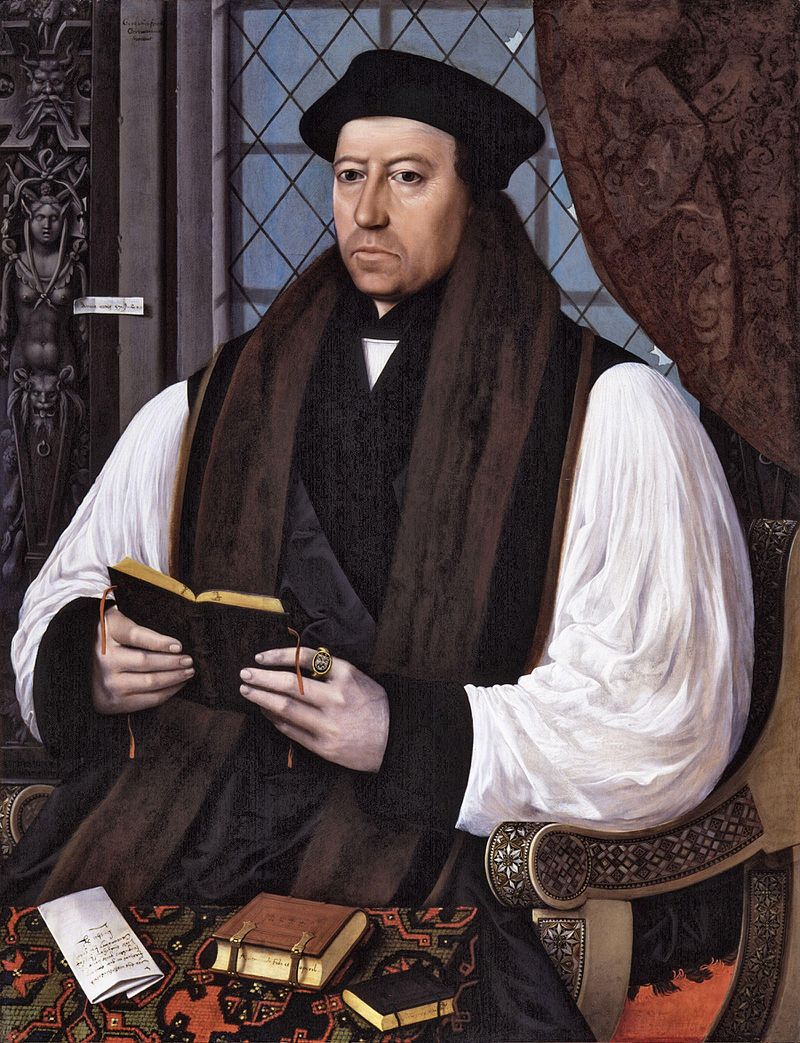
thomas_cranmer

Here is the confession and absolution from the 1552 BoCP:

“ALMIGHTY and most mercyfull father, we have erred and strayed from thy wayes, lyke lost shepe. We have folowed too much the devises and desyres of oure owne hearts. We have offended against thy holy lawes. We have left undone those things whiche we oughte to have done, and we have done those. thinges which we ought not to have done, and there is no health in us: but thou, O Lord, have mercy upon us miserable offendors. Spare thou them, O God, which confesse theyr faultes. Restore thou them that be penitent, according to thy promyses declared. unto mankynde, in Christe Jesu oure Lorde. And graunt, O most merciful father, for his sake, that we may hereafter live a godly, righteous, and sobre life, to the glory of thy holy name. Amen.

The absolucion to be pronounced by the minister alone.

ALMIGHTY God, the father of oure Lord Jesus Christ, which desireth not the death of a synner, but rather that he maye turne from his wickedness and live: and hath geven power and commaundment to hys ministers, to declare and pronounce to his people, beinge penitent, the absolution and remission of their synnnes: he pardoneth and absolveth all them which truely repent, and unfeynedly believe his holy Gospel. Wherefore we beseche him to graunt us true repentaunce and his holy Spirite, that those thinges may please him, which we do at this present, and that the rest of our life hereafter may be pure and holy: so that at the last we may come to hys eternall joye, through Jesus Christ our Lord. Amen.

The Book of Common Prayer is the short title of a number of related prayer books used in the Anglican church, written by Thomas Cranmer, Archbishop of Canterbury. The original book, published in 1549 (Church of England), during the reign of Edward VI, was a product of the English Reformation following the break with the church in Rome. Prayer books, unlike books of prayers, contain the words of structured (or liturgical) services of worship. The work of 1549 was the first prayer book to include the complete forms of service for daily and Sunday worship in English. It contained Morning Prayer, Evening Prayer, the Litany, and Holy Communion and also the occasional services in full: the orders for Baptism, Confirmation, Marriage, Prayers for the Sick, and a Funeral service. The 1549 book was soon succeeded by a more reformed revision in 1552 under the same editorial hand, that of Cranmer. It was used only for a few months, as after Edward VI’s death in 1553, his half-sister Mary I restored Roman Catholic worship. Mary died in 1558 and, in 1559, Elizabeth I reintroduced the 1552 book with a few modifications to make it acceptable to more traditionally minded worshippers, notably the inclusion of the words of administration from the 1549 Communion Service alongside those of 1552.

The Book of Common Prayer (BoCP) has been an instrumental worship book for almost 500 years. The language and flow of the service of many other churches owe a great debt to the BoCP book. In fact many common phrases in English have come from the services in the BoCP. They include:

• “Speak now or forever hold your peace” from the marriage liturgy.
• “Till death us do part”, from the marriage liturgy.
• “Earth to earth, ashes to ashes, dust to dust” from the funeral service.

It is an enduring liturgical resource that still influences our worship today.

Pastor Dave

Epiphany 3A — January 22, 2017

January 22, 2017
Epiphany 3A

“Now when Jesus heard that John had been arrested, he withdrew to Galilee. He left Nazareth and made his home in Capernaum by the sea, in the territory of Zebulun and Naphtali, so that what had been spoken through the prophet Isaiah might be fulfilled: “Land of Zebulun, land of Naphtali, on the road by the sea, across the Jordan, Galilee of the Gentiles—the people who sat in darkness have seen a great light, and for those who sat in the region and shadow of death light has dawned.” From that time Jesus began to proclaim, “Repent, for the kingdom of heaven has come near.” As he walked by the Sea of Galilee, he saw two brothers, Simon, who is called Peter, and Andrew his brother, casting a net into the sea—for they were fishermen. And he said to them, “Follow me, and I will make you fish for people.” Immediately they left their nets and followed him. As he went from there, he saw two other brothers, James son of Zebedee and his brother John, in the boat with their father Zebedee, mending their nets, and he called them. Immediately they left the boat and their father, and followed him.  Jesus went throughout Galilee, teaching in their synagogues and proclaiming the good news of the kingdom and curing every disease and every sickness among the people.” Matthew 4:12-23

“Jesus called ordinary people right in the middle of their ordinary lives to do extraordinary things … and he still does. Jesus issues the same call to us — to be in genuine and real relationships with the people around us, and to be in those relationships the way Jesus was and is in relationship with his disciples and with us: bearing each other’s burdens, caring for each other and especially the vulnerable, holding onto each other through thick and thin, always with the hope and promise of God’s abundant grace. Sometimes that call — to be in Christ-shaped relationship with others — will take us far from home and sometimes it will take shape in and among the persons right around us. But it will always involves persons — not simply a mission or a ministry or a movement, but actual, flesh-and-blood persons. So maybe I should re-state with the theme I started with this way: Jesus called ordinary people right in the middle of their ordinary lives to be in relationship with the ordinary people all around them and through that did extraordinary things … and he still does.” (Pastor David Lose, President, Lutheran Theological Seminary at Philadelphia)

For the Gospel writer John, the response of the first disciples who hear the proclamation of John is “they followed” – and that is the most significant point of this text – it is what mattered most. The key to this text comes in the Greek word “Akolouthein” – translated as “follow”. It can mean to physically “follow behind” someone, or it can mean to “follow as a disciple follows his/her teacher”.

Two of John’s disciples heard John say “Here is the Lamb of God” and they followed Jesus. Just like Matthew the Tax Collector, and James and John and Simon and Andrew (soon to be known as Peter) the fishermen, and then Thomas, the other Simon, Philip, Bartholomew, Thaddaeus, the other James, and finally Judas – they also heard the call of Jesus and followed. They first followed, physically responding to Jesus’ invitation — but it is more significant than that. The initial call comes from Jesus – first asking “what are you looking for?” when he sees that they are following him. Then he invites them to “Come and See”, which they do – but not before Andrew first invites his brother Simon Peter. This becomes a theme in the Gospel of John – people encounter Jesus and they invite someone to “Come and See”. Philip invites Nathaniel – The Samaritan woman at the well invites her community to “come and see this man…”. But their initial following becomes personal – they become disciples, true followers.

I don’t know about you, but the implication, it seems, is clear to me. If this Jesus, the one that is the Lamb of God, the One who is the promise of life, and light, and resurrection, and truth — if this Jesus takes away the sin of the world, what should our response be? Let me say this – our response should be “to follow” Jesus – physically, spiritually, theologically, and as disciples.

Pastor Dave