
On This Date — January 27, 1870

January 27, 2017
The 15th Amendment to the Constitution

“But now that faith has come, we are no longer subject to a disciplinarian, for in Christ Jesus you are all children of God through faith. As many of you as were baptized into Christ have clothed yourselves with Christ. There is no longer Jew or Greek, there is no longer slave or free, there is no Virginia: longer male and female;  for all of you are one in  Christ Jesus. And  if you belong to Christ, then you are Abraham’s offspring, heirs according to the promise.” Galatians 3:25-29
 

15th-amendment

-Seceded: April 17, 1861
-Admitted into C.S.: May 7, 1861
-Readmitted into U.S.: Jan. 26, 1870

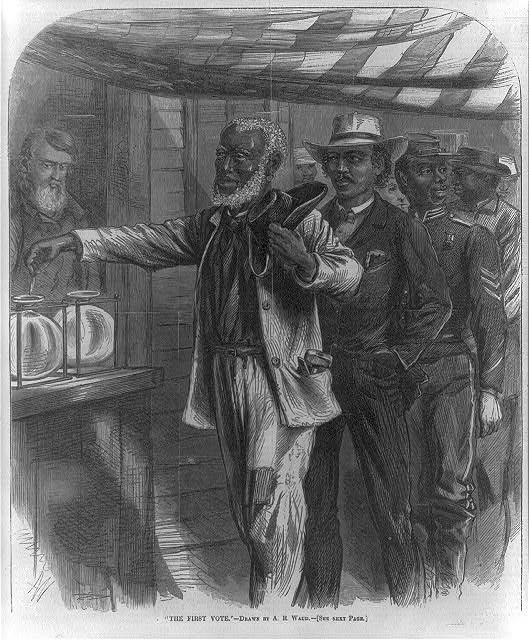
On this date, January 27, 1870, the state of Virginia is readmitted to the Union after accepting the 15th amendment.

The 15th Amendment to the Constitution granted African American men the right to vote by declaring that the “right of citizens of the United States to vote shall not be denied or abridged by the United States or by any state on account of race, color, or previous condition of servitude.” Although ratified on February 3, 1870, the promise of the 15th Amendment would not be fully realized for almost a century. Southern states were able to effectively disenfranchise African Americans through the use of poll taxes, literacy tests and other means. It would take the passage of the Voting Rights Act of 1965 before the majority of African Americans in the South were registered to vote.

My daughter recently went to see the movie Hidden Figures. This movie is based on a true story about a team of African-American women who provided NASA with important mathematical data needed to launch the program’s first successful space missions. In this movie, my daughter first encountered the idea of separate “Black” and “White” bathrooms, lunch counters and entrances and exits. To put it bluntly, she had a lot of questions, and was appalled at the way blacks were treated – and many would say are still treated today. The 15th Amendment, an important piece of legislation that guaranteed the right to vote no matter the color of your skin, still took one hundred years from ratification to the passage of additional legislation to finally see a majority of blacks registered to vote. Why? Well, that is another conversation for me and my daughter to have – because if we do not remember the past, as they say, we are in danger of repeating our mistakes. And with G-d’s blessings, and the help of the Holy Spirit, we will continue to ensure the inalienable rights of all people to “life, liberty and property”, as John Locke would say. Who was John Locke? There is another conversation for another time.

Pastor Dave

On This Date — January 26, 1906

January 26, 2017
Church of God First General Assembly

“When the day of Pentecost had come, they were all together in one place. And suddenly from heaven there came a sound like the rush of a violent wind, and it filled the entire house where they were sitting. Divided tongues, as of fire, appeared among them, and a tongue rested on each of them. All of them were filled with the Holy Spirit and began to speak in other languages, as the Spirit gave them ability.” Acts 2:1-4

church-of-god-history2

On this date, January 26, 1906, the Church of God (Cleveland, Tennessee), a Pentecostal denomination, convenes its first General Assembly.

“The Church of God began on August 19, 1886, in Monroe County, Tennessee, near the North Carolina border. Former Baptist Richard Green Spurling preached in a millhouse along Barney Creek and eight persons formed a Christian Union for the purpose of following the New Testament as their rule for faith and practice, giving each other equal rights and privilege to interpret Scripture, and sitting together as the church of God. Twenty-one years later the growing movement formally adopted the name Church of God. Under the leadership of…first General Overseer, A. J. Tomlinson, the Church of God adopted a centralized form of Church government with an inclusive International General Assembly (1906). (churchofgod.org, “A Brief History of the Church of God”)

“This first Assembly of the “Churches of East Tennessee, North Georgia and Western North Carolina” met January 26-27, 1906. Twenty-one people braved the winter weather to gather in the home of J. C. Murphy, a deacon of the Camp Creek congregation. There they prayed, studied the scriptures and sought answers to important questions that had emerged. The printed minutes of that meeting reflected their restorationism with the preface:

We hope and trust that no person or body of people will ever use these minutes, or any part of them, as articles of faith upon which to establish a sect or denomination. The subjects were discussed merely to obtain light and understanding. Our articles of faith are inspired and given us by the Holy Apostles and written in the New Testament which is our only rule of faith and practice.” (Restorationism and a Vision for World Harvest: A Brief History of the Church of God (Cleveland, Tennessee), David G. Roebuck)

The norm of the Lutheran Church for doctrine and worship, as stated in The Solid Declaration of the Formula of Concord, is:

1. we receive and embrace with our whole heart the Prophetic and Apostolic Scriptures of the Old and New Testaments as the pure, clear fountain of Israel, which is the only true standard by which all teachers and doctrines are to be judged.
2. And since of old the true Christian doctrine, in a pure, sound sense, was collected from God’s Word into brief articles or chapters against the corruption of heretics, we confess, in the second place, the three Ecumenical Creeds, namely, the Apostles’, the Nicene, and the Athanasian, as glorious confessions of the faith, brief, devout, and founded upon God’s Word, in which all the heresies which at that time had arisen in the Christian Church are clearly and unanswerably refuted.

The Formula of Concord (1577) is an authoritative Lutheran statement of faith that, in its two parts (Epitome and Solid Declaration), makes up the final section of the Lutheran Book of Concord.

Each denomination, whether Lutheran, or Church of G-d, or Methodist, will most likely make a similar proclamation – that scripture is the basis and the norm for their articles of faith. Though we do not always agree in doctrine, we do agree that scripture is the inspired and G-d given Word that forms our preaching, our worship and our teachings.

Pastor Dave