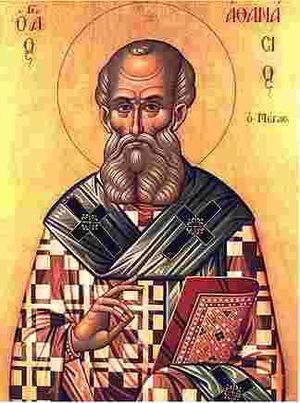
Athanasius, bishop of Alexandria (297/8 – May 2, 373)

 January 7, 2017
Athanasius, bishop of Alexandria (297/8 – May 2, 373)

“Before reaching the age of 20, Athanasius wrote a treatise entitled On the Incarnation, affirming and explaining that Jesus was both God and Man. In about 319, when Athanasius was a  deacon, a presbyter named Arius began teaching that there was a time before God the Father begat Jesus Christ when the latter did not exist. Athanasius responded that the Father’s begetting of the Son, or uttering of the Word, was an eternal relationship between them, not an event that took place within time. Thus began catholic Christianity’s fight against the heresy of Arianism. Athanasius fought consistently against Arianism all his life. He accompanied bishop Alexander to the First Council of Nicaea in 325, which council produced the Nicene Creed and anathematized Arius and his followers. On May 9, 328, he succeeded Alexander as bishop of Alexandria. As a result of rises and falls in Arianism’s influence, he was banished from Alexandria only to be later restored on at least five separate occasions, perhaps as many as seven. This gave rise to the expression “Athanasius contra mundum” or “Athanasius against the world”. During some of his exiles, he spent time with the Desert Fathers, monks and hermits who lived in remote areas of Egypt. (theopedia.com website)

_athanasius_von_alexandria

“Black Dwarf” was the tag his enemies gave him. And the short, dark-skinned Egyptian bishop had plenty of enemies. He was exiled five times by four Roman emperors, spending 17 of the 45 years he served as bishop of Alexandria in exile. Yet in the end, his theological enemies were “exiled” from the church’s teaching, and it is Athanasius’s writings that shaped the future of the church.” (Christianitytoday.com website)

On this day, January 7, 363, Athanasius wrote: “Inasmuch as some have taken in hand to draw up for themselves an arrangement of the so-called apocryphal books and to intersperse them with the divinely inspired scripture…it has seemed good to me…to set forth in order the books which are included in the canon and have been delivered to us with accreditation that they are divine.” (Christianitytoday.com website)

The Lutheran Church has three Creeds – three “I believe” statements.  Two are most familiar, the Apostle’s Creed and the Nicene Creed.  One is hardly used, rarely spoken, and remains the most enigmatic – The Athanasian Creed.  Though named after Athanasius, it was not written by him, nor was it considered a Creed at first.  It was written most likely 100 years after his death by a group of people from the region of southern Gaul.   The main purpose seems to be an apology of the faith against several different heresies; but it also speaks to a sense of high Christology.  It is seldom used in the Lutheran Church today due to its length and the confusing, repetitive style in which it is written.  However, it is worthy to be read by all Christians at least twice a year as a reminder of its poetry and the breadth of the religious statements within.

Pastor Dave
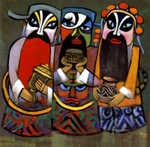
Day of Epiphany

January 6, 2017
Day of Epiphany

“In the time of King Herod, after Jesus was born in Bethlehem of Judea, wise men from the East came to Jerusalem, asking, “Where is the child who has been born king of the Jews? For we observed his star at its rising, and have come to pay him homage.” When King Herod heard this, he was frightened, and all Jerusalem with him; and calling together all the chief priests and scribes of the people, he inquired of them where the Messiah was to be born. They told him, “In Bethlehem of Judea; for so it has been written by the prophet: ‘And you, Bethlehem, in the land of Judah, are by no means least among the rulers of Judah; for from you shall come a ruler who is to shepherd my people Israel.’” Then Herod secretly called for the wise men and learned from them the exact time when the star had appeared. Then he sent them to Bethlehem, saying, “Go and search diligently for the child; and when you have found him, bring me word so that I may also go and pay him homage.”  When they had heard the king, they set out; and there, ahead of them, went the star that they had seen at its rising, until it stopped over the place where the child was. When they saw that the star had stopped, they were overwhelmed with joy. On entering the house, they saw the child with Mary his mother; and they knelt down and paid him homage. Then, opening their treasure chests, they offered him gifts of gold, frankincense, and myrrh. And having been warned in a dream not to return to Herod, they left for their own country by another road.” Matthew 2:1-12

epiphany-adoration-of-the-magi

“And now brothers, I will ask you a terrible question, and God knows I ask it also of myself. Is the truth beyond all truths, beyond the stars, just this: that to live without him is the real death, that to die with him the only life?” (Frederick Buechner, The Magnificent Defeat)

These wise men from the East were probably from Iran, having read the message of the stars from an ancient castle outside of the town of Saveh, some three hours drive from Teheran. There is a 2400 year old castle that still stands today on a hill in the windswept desert, surrounded only by lonely shepherds. Not only were the Magi from a country with which many countries today are in conflict, they were most likely Zoroastrian, a pagan religion of the day that worshipped fire as the symbol of god. The gifts they brought were symbolic of the child’s future. In other words, depending on what gift the child might favor, his or her choice would indicate the nature of their future. If the baby favored gold, he would be a king. If the baby favored the incense of frankincense, he would be a god. And if myrrh were chosen, he’d be a sage – a wise man. Here is an aside – a little interesting tidbit. This tradition of a child favoring gifts that might determine their future is a tradition that is continued at least in the Korean culture, and maybe some other cultures as well. On a baby’s first birthday, numerous gifts symbolizing a possible future are set out before the child – so their possible future vocation is supposedly determined by the child’s choice of a gift. Jesus accepted all three and indeed became all three, a king, a sage, and of course, the Savior of all people.

Pastor Dave