

January 13, 2017
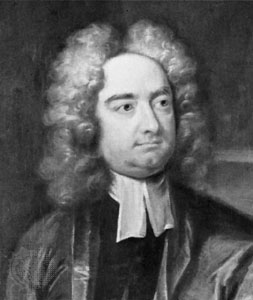
Jonathan Swift, Irish Priest and Author
On this date, January 13, 1695, Jonathan Swift was ordained an Anglican Priest in Ireland. Swift was a satirist, essayist, political pamphleteer, poet and cleric who became Dean of St. Patrick’s Cathedral, Dublin, Ireland. Swift is best known as the author of the book we know as “Gulliver’s Travels”.
“Swift was ostensibly a conservative by nature: he instinctively sought stability in religion as in politics, but stability which insured personal freedoms. Indeed, so far as he was concerned, religion, morality, and politics were inseparable: he consistently attacked theological attempts (even within Anglicanism itself) to define and limit orthodoxy — attempts which, he felt, led ultimately to anarchic dissent. The divisive tendencies of Mankind had, he believed, over the centuries, promoted the general decay of Christianity itself, which had lost its original clarity, simplicity, and coherence. The Truth had been mishandled, corrupted, by men who had behaved like Yahoos. He adhered to the tenets of the Anglican Church because he had been brought up to respect them, because the Church of Ireland was the church of his social class, and because his own ambitions were involved in its success, but also because he saw the Church as a force for rationality and moderation…” (David Cody, Associate Professor of English, Hartwick College, The Victorian Web)
iswiftj001p1
“In the essay (An Argument Against Abolishing Christianity), Swift answers several real and rhetorical arguments against Christianity. First, he responds to the argument that the abolition of Christianity would expand the liberty of conscience by arguing that if great wits could not denounce the Church, they might instead turn to the denunciation of the government, causing political unrest. Swift then addresses the argument that the Church, then supported by government funds, was a drain on resources that might be better spent elsewhere. Swift responds that if the funds used to support the clergy were used instead to fund freethinking young gentlemen, the money would, in short time, be squandered away on vices, and divided by disagreeable marriages. Next, Swift counters the argument that the abolition of Christianity would open up another day of the week (the Sabbath) to commercial activities for the benefit of the nation by arguing that the Sabbath provides benefits by allowing lawyers time to write their briefs, merchants to tally their books, and others to exercise, go to coffeehouses, and otherwise enjoy themselves, ironically implying that the argument is specious because the Sabbath was not kept as intended in any case.” (Wikipedia, an explanation of the contents of the pamphlet An Argument Against Abolishing Christianity, a satirical essay written by Swift)
Jonathan Swift was a man this pastor can appreciate – especially his use of wit to make a point. This pastor often tries to use humor to make a point or to highlight the absurdity of a situation. Swift’s wit and humor is so very evident in the following statement: “he responds to the argument that the abolition of Christianity would expand the liberty of conscience by arguing that if great wits could not denounce the Church, they might instead turn to the denunciation of the government, causing political unrest.” I appreciate his statement having been a pastor now for the last eleven years. I often wonder how people might get along in their lives if there was nothing to complain about in the church. Imagine if the bulletin had zero mistakes: what model would we have to compare our own lives? How bad might we feel about ourselves with such exposure to perfection? Or, imagine if the pastor never disagreed with us when we brought up our disagreement with theological understanding? How could we live with a G-d we could completely manipulate?
Humor is not always appropriate, but it can be used effectively to help us all find perspective, both in our personal lives, and in our spiritual lives.
Pastor Dave
 Lutheran Schreff