

January 7, 2017
Athanasius, bishop of Alexandria (297/8 – May 2, 373)
“Before reaching the age of 20, Athanasius wrote a treatise entitled On the Incarnation, affirming and explaining that Jesus was both God and Man. In about 319, when Athanasius was a deacon, a presbyter named Arius began teaching that there was a time before God the Father begat Jesus Christ when the latter did not exist. Athanasius responded that the Father’s begetting of the Son, or uttering of the Word, was an eternal relationship between them, not an event that took place within time. Thus began catholic Christianity’s fight against the heresy of Arianism. Athanasius fought consistently against Arianism all his life. He accompanied bishop Alexander to the First Council of Nicaea in 325, which council produced the Nicene Creed and anathematized Arius and his followers. On May 9, 328, he succeeded Alexander as bishop of Alexandria. As a result of rises and falls in Arianism’s influence, he was banished from Alexandria only to be later restored on at least five separate occasions, perhaps as many as seven. This gave rise to the expression “Athanasius contra mundum” or “Athanasius against the world”. During some of his exiles, he spent time with the Desert Fathers, monks and hermits who lived in remote areas of Egypt.” (theopedia.com website)
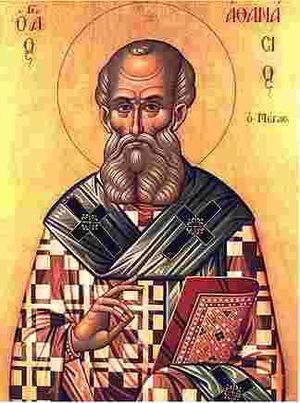
“Black Dwarf” was the tag his enemies gave him. And the short, dark-skinned Egyptian bishop had plenty of enemies. He was exiled five times by four Roman emperors, spending 17 of the 45 years he served as bishop of Alexandria in exile. Yet in the end, his theological enemies were “exiled” from the church’s teaching, and it is Athanasius’s writings that shaped the future of the church.” (Christianitytoday.com website)
On this day, January 7, 363, Athanasius wrote: “Inasmuch as some have taken in hand to draw up for themselves an arrangement of the so-called apocryphal books and to intersperse them with the divinely inspired scripture…it has seemed good to me…to set forth in order the books which are included in the canon and have been delivered to us with accreditation that they are divine.” (Christianitytoday.com website)
The Lutheran Church has three Creeds – three “I believe” statements. Two are most familiar, the Apostle’s Creed and the Nicene Creed. One is hardly used, rarely spoken, and remains the most enigmatic – The Athanasian Creed. Though named after Athanasius, it was not written by him, nor was it considered a Creed at first. It was written most likely 100 years after his death by a group of people from the region of southern Gaul. The main purpose seems to be an apology of the faith against several different heresies; but it also speaks to a sense of high Christology. It is seldom used in the Lutheran Church today due to its length and the confusing, repetitive style in which it is written. However, it is worthy to be read by all Christians at least twice a year as a reminder of its poetry and the breadth of the religious statements within.
Pastor Dave
 Lutheran Schreff