

January 31, 2017
The City of Milwaukee – The Milwaukee Bridge War
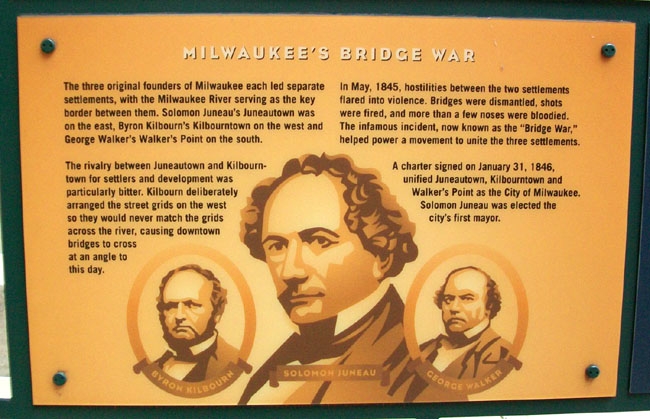
Milwaukee’s Bridge War Marker
The Milwaukee Bridge War was an 1845 conflict between people from Juneautown and Kilbourntown over the construction of a bridge. The early history of Milwaukee was marked by the rivalry between Juneautown and Kilbourntown, mostly due to the actions of Byron Kilbourn. Kilbourn had been trying to isolate Juneautown to make it more dependent on Kilbourntown. For example, when he laid out his street grid in 1835, he paid no attention to the existing street layout of Juneautown. Kilbourn’s maps showed Juneautown as a blank space, and when steamers delivered goods to Kilbourn’s west side docks, he ordered the captains to tell passengers that Juneautown was an Indian trading post.
Eventually five bridges were built over the Milwaukee River. One was supported financially by Solomon Juneau. Another was supported financially by Byron Kilbourn. The other three were unfavorable to Byron Kilbourn because he felt they interfered with boat traffic on the Milwaukee. On 3 May 1845, a schooner rammed into one of the bridges, it was supported by Kilbourn. His supporters blamed Solomon Juneau with a conspiracy stating he paid the boat captain to ram the bridge. Kilbourn’s supporters held a meeting and decided that Solomon Juneau’s bridge had become an “insupportable nuisance”. These followers gathered tools and took down half of Juneau’s bridge, collapsing it. Angry supporters of Juneau gathered weapons including an old cannon. The cannon was aimed at Kilbourn’s home, but they held their fire when they learned that Kilbourn’s young daughter had just died.
The next few weeks were tense: supporters of Kilbourn and Juneau were attacked and injured. Eventually tempers slowly cooled as the year went on. In December, trustees put together a plan and drafted a city charter. After the Milwaukee Bridge War, on January 31, 1846, Juneautown and Kilbourntown unified as the City of Milwaukee, Wisconsin.
Not every city in America has such a colorful genesis – born out of conflict and argument. Since it was in the deep of winter that their agreement was finalized, my guess is that they were all too cold to care any more and just wanted to end the stalemate. Who wants to be out prowling around looking for a fight in January in Wisconsin? Not me. Once again, we see how the greed of the individual can become the suffering of the masses. In this case it was more the greed and deceit of Byron Kilbourn – and Solomon Juneau reacted as many of us might have in the same situation – to protect what was his own. Now we see how the 8th Commandment can be such a challenge for us. The 8th Commandment is: “You shall not bear false witness against your neighbor”. Luther’s explanation of this commandment says thus:
We should fear and love God that we may not deceitfully belie, betray, slander, or defame our neighbor, but defend him, [think and] speak well of him, and put the best construction on everything.
Come to think of it, this disagreement also includes the 9th and 10th Commandments as well: “You shall not covet your neighbors (things) – house, property, spouse, etc.”
In the end, the people of Milwaukee came together and put the Bridge War behind them. In this day of so much conflict and disagreement, we pray that our country and its citizens will also learn to put aside our differences and find ways to work together for peace and prosperity.
Pastor Dave

 Lutheran Schreff