
Comforting Ointment Or The Fire of Reproof? — Rev. David J. Schreffler

Image result for pictures of treating gangrene on leg


December 23, 2015

“There are also many rebellious people, idle talkers and deceivers, especially those of the circumcision; they must be silenced, since they are upsetting whole families by teaching for sordid gain what it is not right to teach. For this reason rebuke them sharply, so that they may become sound in the faith, not paying attention to Jewish myths or to commandments of those who reject the truth. To the pure all things are pure, but to the corrupt and unbelieving nothing is pure. Their very minds and consciences are corrupted. They profess to know God, but they deny him by their actions. They are detestable, disobedient, unfit for any good work.” Titus 1:10 – 16

One who remains uncorrected, and who does not correct others, becomes like a limb which purifies, and corrupts the whole body. It is like an inept physician who, when a limb had already begun to be corrupted, placed ointment immediately upon it, without having first burnt the wound. So it is with the pastor or any other person having received the duty of care of souls, on seeing someone putrefying from the corruption of mortal sin. If one applies to him the ointment of soft words and encouragement alone, without reproof, one would never cure him…If he were a good physician who cares about those souls…he would not give comforting ointment without the fire of reproof.” (Catherine of Sienna [1347 – 1380] A Treatise of Prayer, “For All The Saints” volume III, p. 107)

I was sitting in a coffee shop the other day, and without straining much, I was privy to a conversation a mother was having with her son about his life on a college campus. It was obvious this young man has had his problems in life, but according to his own admission, he is maturing, doing well in school, trying to make amends with family and friends. One comment he made to his mother made me think – he said even though he still may be doing things that society may not approve, he is bothered by the hypocrisy that adults show him in their treatment of him, even when he knows these parents were not angels when they were his age. He is having trouble with what appears to him to be a “double standard” – the proverbial “do as I say, not as I do (or did)”.

Sometimes we are afraid to tell our children that something they are doing is wrong because we did the same thing when we were their age. This is the age old dilemma for a parent. None of us, and yes I speak with a broad brush here, but most of us would not want our children to repeat the same mistakes we made. And, as parents, we should reprove, correct, and guide our children as best we can. Maintaining the attitude that “well I did it when I was their age so why shouldn’t they” may be ok in some circumstances, but may not be for others. We need to maintain discerning minds when we are correcting our children. And, the same can be true with our fellow Christians in the church. Some behaviors need to be corrected – or at least pointed out – and yes, in doing so, we run the risk of someone pulling out Matthew 7:3: Why do you see the speck in your neighbor’s eye, but do not notice the log in your own eye? In fact, my own son has used this scripture on me. But that did not stop me from saying my peace – whether hypocritical or not – my job is to reprove. And if that brings to light my own hypocrisy, so be it. I cannot shirk my responsibility for correcting just because I am human, sinful, and prone to making mistakes.

Pastor Dave
The Cost Of Free Will — Rev. David J. Schreffler

image

December 22, 2015

“For God so loved the world that he gave his only Son, so that everyone who believes in him may not perish but may have eternal life. “Indeed, God did not send the Son into the world to condemn the world, but in order that the world might be saved through him. Those who believe in him are not condemned; but those who do not believe are condemned already, because they have not believed in the name of the only Son of God. And this is the judgment, that the light has come into the world, and people loved darkness rather than light because their deeds were evil. For all who do evil hate the light and do not come to the light, so that their deeds may not be exposed. But those who do what is true come to the light, so that it may be clearly seen that their deeds have been done in God.” John 3:16 – 21

“G-d created things which had free will. That means creatures which can go either wrong or right. Some people think they can imagine a creature which was free but had no possibility of going wrong; I cannot. If a thing is free to be good it is also free to be bad. And free will is what has made evil possible. Why, then, did G-d give them free will? Because free will, though it makes evil possible, is also the only thing that makes possible any love or goodness or joy worth having. A world of automata—of creatures that worked like machines—would hardly be worth creating. The happiness which G-d designs for His higher creatures is the happiness of being freely, voluntarily United to Him and to each other in…..love.” (C. S. Lewis [1898 – 1963], Mere Christianity, “For All The Saints”, volume III, p. 102)

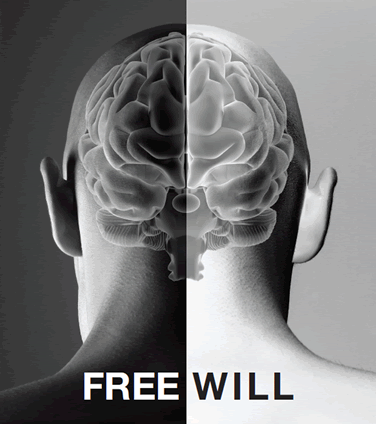
Free will. What a topic. Predestination is the concept that all events of history, past, present and future, have been decided or are known (by God, fate, or some other force), including human actions. This is a power that is contrary to free will. True free will would mean that nothing, no person, event or other factor would help to determine a decision or course of action. Does a person have free will? Does a person live in a place, world, community, or family where their decisions have no outside influence? Some people would claim that they have complete free will – while others would point to karma, fate, or influence of some kind affecting every decision.

There was a study completed a few years ago that seemed to point to the fact that true free will may not actually be “a thing”. Here was the study. They strapped electrodes to the brains of subjects, and asked them to make random selections of objects – to choose between one object or another. They were to clear their minds, and when directed, make a choice, spontaneously. What the study showed is this: though the subject making the choice seemed to do it free of any outside stimuli, something in the brain fired a few microseconds before the choice was made. It suggests that there may be nothing called “complete free will”.

In this country, we claim a lot of freedoms, and few of them are freedoms that happen on a molecular level. One of the freedoms we hold dear is the freedom of the will, or in other words, I hold that if my conscience is bound, I should not be forced to do certain things.

“God isn’t about making good things happen to you, or bad things happen to you. He’s all about you making choices–exercising the gift of free will. God wants you to have good things and a good life, but He won’t gift wrap them for you. You have to choose the actions that lead you to that life.”
― Jim Butcher

To exercise your power and freedom to choose, you have to make choices. G-d has freely chosen you, because G-d created you. You then have the choice to live into the blessings you have, or to let others squelch them. “It was for freedom that Christ set us free; therefore keep standing firm and do not be subject again to a yoke of slavery” (Galatians 5:1)

Pastor Dave