

December 9, 2015
“Then the Pharisees went and plotted to entrap him in what he said. So they sent their disciples to him, along with the Herodians, saying, “Teacher, we know that you are sincere, and teach the way of God in accordance with truth, and show deference to no one; for you do not regard people with partiality. Tell us, then, what you think. Is it lawful to pay taxes to the emperor, or not?” But Jesus, aware of their malice, said, “Why are you putting me to the test, you hypocrites? Show me the coin used for the tax.” And they brought him a denarius. Then he said to them, “Whose head is this, and whose title?” They answered, “The emperor’s.” Then he said to them, “Give therefore to the emperor the things that are the emperor’s, and to God the things that are God’s.” When they heard this, they were amazed; and they left him and went away.” Matthew 22:15 – 22
“The church must speak when the law of God is transgressed. The relationship between church and state has assumed many different forms throughout the ages. This is purely an organizational matter which does not affect the nature of the church. In reality there must be some regulations governing the relationship between church and state—it is only a question of what kind. A close association may further the work of the church, but it may also prove a hindrance because of the pressure the state is able to exert. A closer connection between church and state presupposes that the state recognizes the significance of the work of the church.” (The Faith of the Christian Church, Gustav Aulen (1879 – 1978) “For All The Saints” volume III, p. 37)
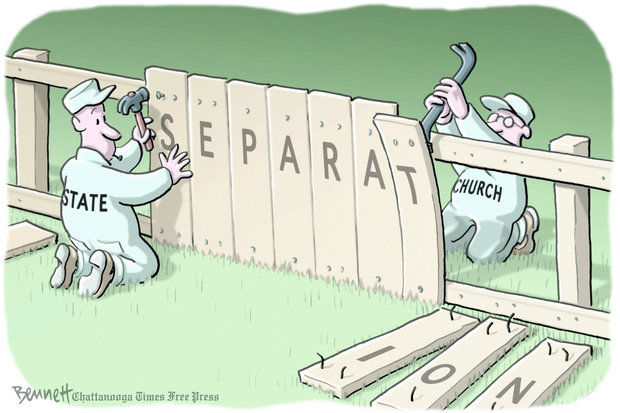
Today, in this day and age, does the state recognize the work of the church? In this day and age, does the state influence the work of the church? Aulen goes on to say that “There is nothing about which the church is more sensitive than the attempt of the state to give directives for and establish limits to the preaching of G-d’s word.” As a preacher I cannot agree more with his statement. Having lived and taught in Sweden, I would guess he would have been influenced by both world wars, and would have seen the church being influenced and threatened by the state in various ways.
I am worried today that the State may be trying to get involved in the teaching of the church in clearing the way for same sex weddings. I am not going to use this platform to try to claim I am for or against the idea, but I do not want the State coming in to the congregations of Pennsylvania and forcing the issue. As it stands right now, I can make a decision if I will or won’t perform a wedding – and the reasons can be manifold. The date may not be open in our schedule. I may finish counseling with the couple and decide that my conscience is not in favor of the wedding, and that decision I make stands for all couples. Or, I may feel I just do not have the time in my schedule. It seems clear to me that the State, and the court of public opinion, has opened the way for a couple to be refused by the church to perform their wedding, on a whole host of reasons, and the couple can claim we are bigoted and sue us for the “right” to have their wedding performed in our congregations. We may have clear and reasonable issues with the wedding, but the court of public opinion will slay us, and the state will not support the church’s decision.
You think I am crazy – or even worse, intolerant or a bigot? Do I not have a right to have a bound conscience for or against anything? How far away are we from the State interfering with the freedom of religion?
Pastor Dave
 Lutheran Schreff